
Imagine a place where one million acres of emerald woods meet sky-blue mountain streams, and the only traffic jam involves a family of deer crossing a gravel road. In 2026, as travelers increasingly ditch overcrowded hotspots for authentic wilderness, a longstanding question echoes louder than ever: why battle selfie-stick crowds at a theme park when you can have an entire national forest practically to yourself? The answer lies in the Ozark-St. Francis National Forests, a twin treasure hidden in plain sight across northern and eastern Arkansas. While the state rakes in fame for Hot Springs and the flashy Crystal Bridges Museum, these forests remain a masterpiece of subtlety — a place where nature pulls out all the stops without ever raising its voice.
Straddling the rugged Ozark Mountains and the soft, delta-kissed flatlands of eastern Arkansas, this combined wonderland is essentially two national forests in one sprawling embrace. The Ozark National Forest gulps down a staggering 1.2 million acres of hardwood and pine, while its smaller sibling, the St. Francis National Forest, contributes a cozy 22,600 acres of Mississippi River-adjacent charm. Their secret sauce? A complete absence of entrance fees. Yes, you read that correctly — in an era where a parking spot at some trailheads can cost more than a decent meal, Ozark-St. Francis waves the cover charge, open 24/7 like the world’s most generous artist’s studio.
A visitor in 2026 might wonder: what’s the catch? There isn’t one, apart from having to embrace the forest’s delightfully analog rhythm. Camping pitches are first-come, first-served — no reservation bots, no booking windows that open at midnight only to crash. This is old-school adventure, where spontaneity still reigns. But don’t confuse charmingly rustic with unprepared. As district offices will cheerfully remind anyone, a million-acre forest comes with a million potential surprises, from flash thunderstorms to trails that double as ankle-turning obstacle courses. Checking official maps and visitor-center alerts before heading out isn’t just recommended; it’s the difference between a transcendent sunrise hike and a very soggy lesson in humility.
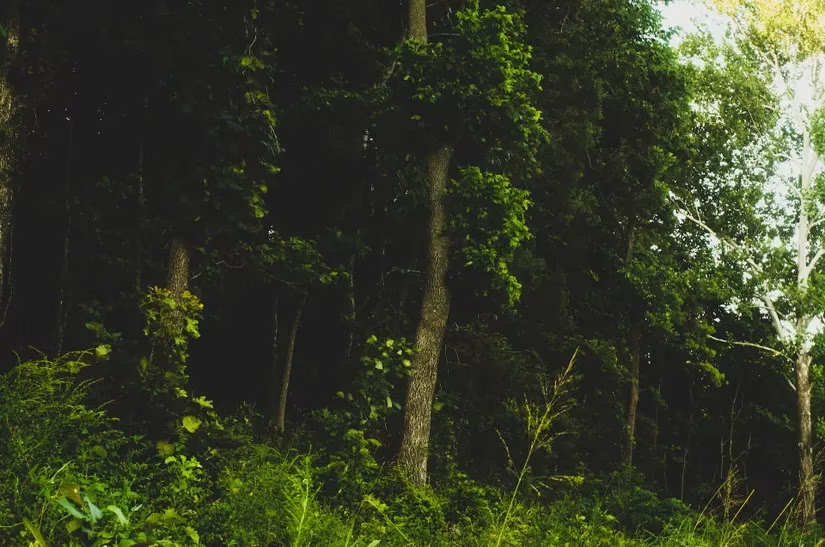
What lures the curious traveler back again and again? For starters, the seasonal theatrics are nothing short of hypnotic. Spring unrolls a psychedelic carpet of dogwood and redbud blossoms, while autumn, ever the show-off, ignites the forest into a palette of screaming oranges, bruised purples, and honeyed yellows. It’s the kind of beauty that makes even the most cynical hiker mutter “not bad” while secretly filling up an entire memory card. Yet these forests aren’t just a backdrop for leaf-peeping; they’re a full-sensory playground. Fishing, mountain biking, horseback riding, and canoeing paint broad strokes of adrenaline, but intimate moments steal the show — like standing knee-deep in a cold creek with nothing but the sound of a distant woodpecker keeping time.
Now, let’s talk trails, because that’s where the Ozark-St. Francis National Forest truly flexes its muscles. And yes, the hikes have names so whimsical you’d think they were invented by an Appalachian bard.
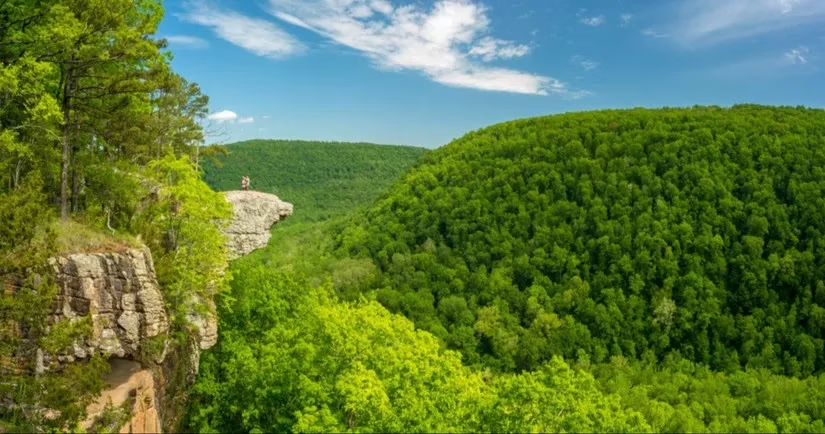
Hawksbill Crag (Whitaker Point Trail) remains the crown jewel. In 2026, the trailhead off County Road 5 still doesn’t boast any fancy welcome center — just a white sign and a parking lot that feels like a social experiment on busy weekends. Hikers snake through a dense hardwood forest for about an hour before the world drops away, revealing the iconic rock formation jutting out like a hawk’s beak over a vast valley. The view frames Whitaker Creek below, and the wind up there has a habit of making every visitor feel profoundly small and exponentially grateful. At 2.6 miles round-trip and moderate difficulty, it’s imminently doable, though the final rocky perch isn’t for those nursing a fear of heights.
Glory Hole Falls sounds like something out of a roadrunner cartoon, and it’s every bit as surreal. Water doesn’t plunge over a cliff — it vanishes through a perfectly circular hole in the rock ceiling, plummeting into a mossy grotto below. The 1.9-mile out-and-back trail starts as a retired jeep path downhill, then morphs into a narrow, root-tangled footpath. Frequent visitors in 2026 still argue about the best time to catch the spectacle: a deluge in late spring turns it into a thunderous column, while a dry spell reduces it to a polite trickle. Pro tip: go right after a heavy rain and watch the forest perform a magic trick.
For those with a taste for the wilder side, the Devils Canyon Scenic Area Trail serves up a 3.1-mile loop of pure Ozark drama. Two waterfalls, canyon walls draped in ancient hardwoods, and a mandatory scramble that involves boulder-hopping beside a cheerful creek. The bushwhack portion isn’t a euphemism — it’s a genuine reminder that sometimes the best paths are the ones not groomed to perfection. Hikers emerging from the canyon often sport dirt-streaked smiles and a renewed respect for their quadriceps.
Beyond the trails, the forests harbor countless secrets for the unhurried wanderer. Scenic drives slice through the Ozark highlands, linking one jaw-dropping overlook to the next without requiring a drop of sweat. Canoeing on the lazy stretches of the Mulberry River offers a front-row seat to herons hunting breakfast, while campgrounds tucked under pines become impromptu constellations under a sky blissfully free of light pollution. The 2026 traveler — perhaps weary of virtual realities — finds here an unapologetically analog recharge that no app can replicate.
Practicalities, although boring, keep the dream alive. Visitors should pack for moody weather: a sun-drenched morning can dissolve into a hilltop drizzle by noon. Water, snacks, and a paper map (yes, paper, because cell signal laughs at your five bars) are non-negotiable. District offices have been known to offer helpful updates on washed-out roads or the whereabouts of particularly photogenic wildflower patches, so a quick check-in isn’t a bureaucratic chore — it’s an insider’s ticket.
So, is the Ozark-St. Francis National Forest worth the detour in 2026? The answer might just be found in that moment when a hiker stands atop Hawksbill Crag, watching a hawk trace lazy circles against an impossibly blue sky, and realizes that some treasures don’t need to advertise. They simply wait.
Comments