
As a traveler who has spent years exploring the Southern Atlantic Coast, I've watched beloved beach towns transform from serene escapes into bustling scenes of packed sands and endless lines. By summer 2026, the pressure of overtourism has only intensified in hotspots like Charleston, Hilton Head, and Florida's eastern shores. But beneath the radar, a string of unspoiled hideaways still thrive — places where you can hear the rhythm of waves instead of conversation, and where wildlife roams without fear. I took it upon myself to visit these quieter corners this past season, and what I found was a collection of crowd-free treasures that deliver the calm many of us crave.
One spot that rewired my definition of a perfect beach day is Playalinda Beach near Titusville, Florida. Its name means 'pretty beach' in Spanish, and the description is almost an understatement. This undeveloped shoreline is part of the Canaveral National Seashore, and it rewards visitors with miles of pristine, sun-drenched sand. Unlike the congested stretches of Daytona or Miami, Playalinda remains blissfully empty. I spent hours sauntering along the water’s edge, spotting only a handful of other souls, and took spontaneous dips whenever the heat rose. The real thrill, however, is its proximity to a active rocket launch complex. In 2026, with launch cadences increasing, you might witness a SpaceX or NASA rocket streaking into the sky right from your beach towel — just check the seashore's event calendar so a sudden roar doesn’t startle you out of a nap.

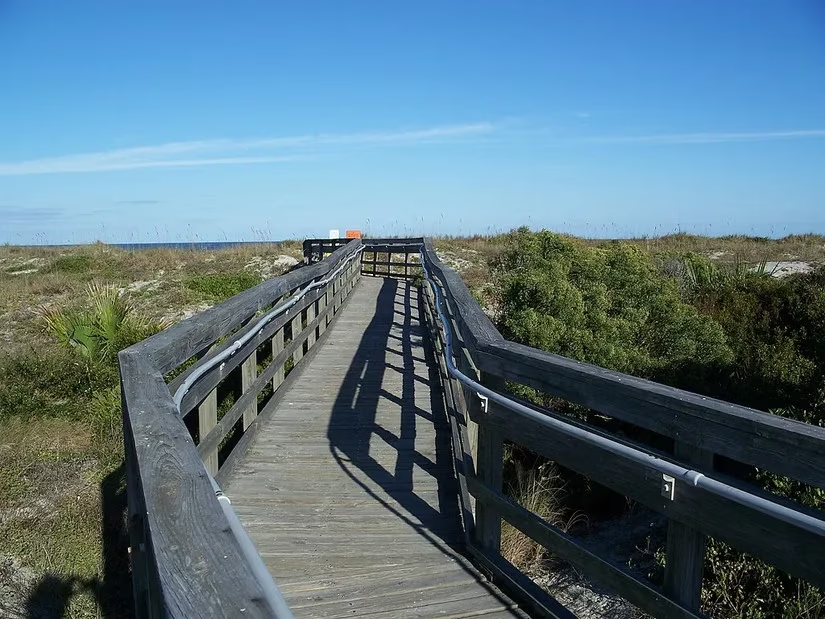
Further north, Florida continues to surprise with Little Talbot Island State Park, a place I discovered while trying to escape the crowds that plague Wekiwa Springs and Hillsborough River. This park is an oasis of quietude, sitting on a small, undeveloped barrier island. I explored over five miles of untrammeled coastline and wandered through maritime forests on a network of bike trails. The boardwalk that leads to an ocean overlook became my favorite sunrise spot — no tour buses, no selfie-stick jostling, just the salt breeze and a chorus of shorebirds. Wildlife encounters here feel intimate; I saw marsh rabbits nibbling on grass and once caught a glimpse of a bobcat slipping through palmetto shadows, a testament to how undisturbed the habitat remains.
South Carolina’s lowcountry holds its own trove of hidden enclaves. A short 15-mile drive from the lively center of Beaufort brings you to Hunting Island State Park, a secluded barrier island spanning 5,000 acres. I pitched a tent in the semitropical forest, fell asleep to crashing surf, and woke to discover that I shared the campground with deer and thousands of fiddler crabs. The beach here feels deliciously remote — you can swim in gentle surf or hike maritime forest trails where I spotted an alligator sunning near a freshwater lagoon and later, on a dolphin cruise, watched a pod of bottlenose frolic in the inlet. It’s a pocket of tranquility that makes you forget civilization is only a quarter-hour away.
For travelers who want relaxation without sacrificing soft comforts, Isle of Palms Beach near Charleston is a revelation. While most visitors flock to the city’s historic districts and crowded shores, I found this barrier island to be a serene hybrid: empty stretches of sand at dawn, then gentle afternoons spent browsing boutique shops or playing a round of golf. Wellness seekers can book a spa session while the ocean hums in the background. It’s a place where you can catch a sunrise, snooze under an umbrella, and still be back in time for a farm-to-table dinner without ever feeling hurried.
Farther off the mainland, the interior ocean-facing Turtle Beach on Daufuskie Island delivers a raw, rustic escape. Only accessible by boat, this slice of South Carolina’s coast offers 4.5 miles of shoreline backed by a second-growth maritime forest. But the real enchantment happens between May and summer, when more than 5,000 sea turtle nests appear along the sand. I was lucky enough to observe a loggerhead lumber ashore at dusk — an experience made possible by the beach’s ultra-low visitor numbers. Loggerheads, greens, Kemp’s ridleys, and leatherbacks all rely on this sanctuary, and early May is the prime moment to witness the nesting season’s fiery start.
Inland but no less magical is Congaree National Park, just 25 minutes from Columbia, South Carolina. Some dismiss it as the nation's 'worst' national park due to a lack of ziplines or souvenir shops, but that’s precisely why I adore it. This vast old-growth bottomland hardwood forest is a cathedral of champion trees and oxbow lakes, where the Congaree and Wateree Rivers flood the plain and nourish an extraordinary ecosystem. I paddled a kayak through cypress-lined waterways with no other humans in sight, and later hiked a boardwalk loop where I encountered plain-bellied water snakes, flutters of hermit thrushes, and the unmistakable tracks of wild boar. Few visitors mean nature runs the show, and in 2026, that rarity is a priceless gift.
Finally, Alabama’s quiet coast holds a winged wonderland: the Audubon Bird Sanctuary Beach on Dauphin Island. This 164-acre refuge is a critical stopover for neotropical migrants crossing the Gulf of Mexico. Walking the half-mile interpretative trail through dunes, swamp, and freshwater lake, I was serenaded by warblers and watched a white ibis pick its way along the water’s edge. In early fall, up to 347 species pass through, creating a spectacle of color and song that rivals any crowded boardwalk. The beach itself is soft and empty, perfect for a picnic after a morning of birding.
From Florida’s rocket-launch beach to Alabama’s avian haven, these Southern coastal gems share a common thread: they offer the space to breathe deeply and reconnect with nature. In 2026, as travel numbers continue to soar, I’ve found that the truest luxury isn’t an exclusive resort — it’s a stretch of sand where you feel like the only person on Earth. Seek out these serene hideaways, and you’ll trade bumper-to-bumper traffic for the whisper of wind through sea oats and the distant splash of a dolphin. The quiet side of the South is waiting.
Comments